
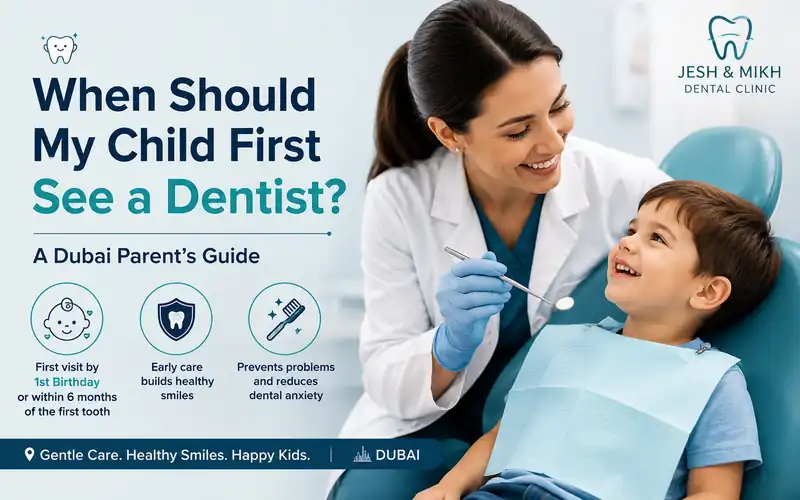
When Should My Child First See a Dentist? A Dubai Parent's Guide
Most parents wait until their child has a full set of teeth before scheduling a dental visit. By then, early childhood decay, harmful feeding habits, and developmental concerns may already be present. The standard recommendation from paediatric dental organisations worldwide is earlier than almost every parent expects. This guide covers everything you need to know about dental care for your child in Dubai, from the first tooth to the teenage years.
 The First Dental Visit: Earlier Than You Think
The American Academy of Pediatric Dentistry and the British Society of Paediatric Dentistry both
recommend scheduling a child's first dental visit by their first birthday, or within 6 months of the first
tooth appearing, whichever comes earlier.
This surprises many parents. The purpose of an early visit is not to perform treatment. It is to examine
the developing mouth, identify any early signs of decay, advise parents on feeding habits and brushing
technique, and, most importantly, establish a positive relationship between the child and the dental
environment before any treatment is ever needed.
(Source: AAPD Oral Health Policies and Recommendations)
Why Baby Teeth Matter More Than Most Parents Realise
A common and understandable misconception is that baby teeth are temporary, so their condition is less
important. This is not accurate.
Baby teeth serve several critical functions. They hold space in the jaw for the adult teeth developing
beneath them. They guide the adult teeth into their correct positions as they erupt. They support proper
speech development, jawbone growth, and chewing function. They are present from approximately 6
months to 12 years of age, covering a full decade of development.
When a baby tooth is lost prematurely due to decay or infection, the neighbouring teeth shift into the
gap. The adult tooth beneath then has no clear path to erupt correctly, leading to crowding and
misalignment that may require years of orthodontic treatment later.
(Source: Early childhood caries and its developmental consequences)
What Happens at a Child's First Dental Visit?
A first visit for a young child is designed to be entirely positive. There is no drilling, no injections, and no
treatment unless an urgent problem is found. Here is what typically happens:
What Is Early Childhood Caries?
Early childhood caries (ECC), sometimes called baby bottle tooth decay, is the most common chronic
disease in children worldwide. It occurs when teeth are exposed to sugar-containing liquids repeatedly
over time, most commonly from bottles containing formula, juice, or sweetened drinks given at nap or
bedtime.
When a child sleeps with a bottle, the liquid pools around the front teeth for hours. The bacteria in
dental plaque convert this sugar into acid, and the acid attacks the enamel of newly erupted, relatively
soft baby teeth. The result can be widespread decay affecting multiple teeth in a child under 2 years of
age.
ECC is largely preventable. Never put a child to bed with anything in a bottle other than water. Wipe the
gums with a damp cloth even before teeth emerge. Begin brushing as soon as the first tooth appears.
 A Parent's Guide to Brushing by Age
| Age | Toothpaste Amount | |
|---|---|---|
| 0 to 6 months | None | Wipe gums with a damp cloth after feeding |
| 6 months to 3 years | Rice-grain sized | Use fluoride toothpaste, brush for 2 minutes, parent does the brushing |
| 3 to 6 years | Pea-sized | Parent supervises and assists, spit but do not rinse |
| 7 to 12 years | Pea-sized | Parent supervises, child brushes independently |
| 12 years and over | Standard adult amount | Independent brushing, introduce flossing |
Fluoride: Is It Safe for Children?
Fluoride is one of the most thoroughly researched and proven interventions in preventive dentistry. It
strengthens tooth enamel and significantly reduces the risk of decay. The amount of fluoride in ageappropriate toothpaste is safe for children when used in the recommended quantities.
Fluoride varnish applied by a dentist at checkup appointments provides additional protection and is
recommended from the time the first tooth appears. It is quick, painless, and highly effective.
(Source: WHO position on fluoride and dental health)
Managing Dental Anxiety in Children
Dental anxiety in children most commonly develops from a negative early experience, or from anxiety
absorbed from parents who are themselves nervous about dental visits. The single most effective way
to prevent dental anxiety is early, positive, low-pressure exposure before any treatment is needed.
When bringing a young child to the dentist, keep your language positive and neutral. Avoid words like
pain, needle, or drilling. Do not promise the visit will be fine and then contradict this if treatment is
needed. Children respond well to honesty framed in age-appropriate, reassuring language.
At a good pediatric-friendly clinic, the team are trained in behaviour management techniques designed
specifically for children. Tell-show-do, positive reinforcement, and distraction are standard approaches
that make a significant difference to a child's experience.
When to Consider an Orthodontic Assessment
Most orthodontists recommend a first orthodontic assessment around age 7 to 8, when enough adult
teeth have erupted to identify developing alignment problems. This does not mean treatment begins at
this age. It means a specialist can identify whether early intervention would reduce the complexity of
treatment later, or simply monitor and intervene at the optimal time.